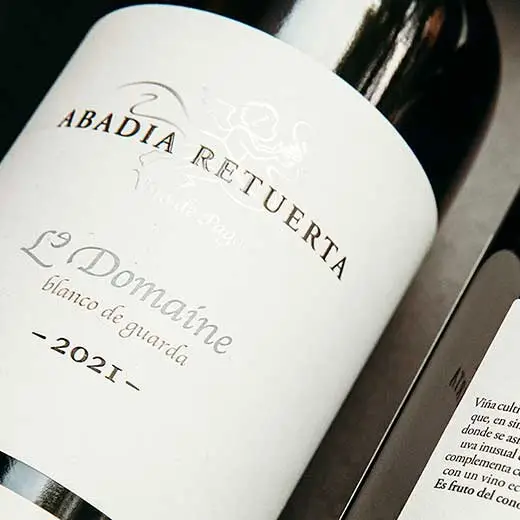
The rebirth of a historic vineyard and the excellence of a winemaking tradition, which remains intact, were the foundations of the Abadía Retuerta winery. Now, with more than 30 years of history, where expert hands guide the vineyard, watch over its care and elaborate unique wines and lay the foundations of this project.
A winemaking tradition precedes it. A land bathed by the Douro excellent for the cultivation of the vine, with a vision of the future and a pact between nature, care and time until today.
Historical Context
Historians confirm that the vine is a crop that comes from the Near East. Its introduction into the Peninsula is attributed to the Romans, who spread the vine throughout the north of the peninsula, reaching the lands of the Duero and, therefore, the lands of Abadía Retuerta at the beginning of the Christian era…
Christians, in the 12th centuryfounded their monasteries and the enclave of the Duero, as we know it today.. The monks persisted in the cultivation of vineyards and, little by little, in addition to extracting the best from those lands, dominated winemaking. Thanks to the transfiguration capacity and the vineyard’s own obstinacy to settle down, our most precious commodity, wine, continued to be one of the best products of the land.
Monastery of Our Lady Saint Mary of Retuerta
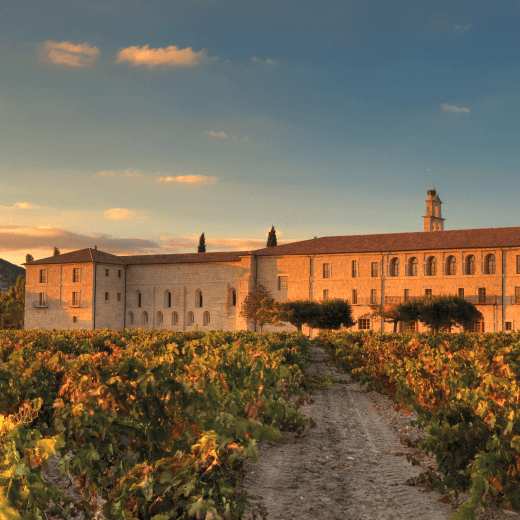
During the 11th century of the Christian era and coinciding with the decline of the power of the Muslim armies, a historical cycle culminates in the lands near the Duero River. A historical cycle culminated in the lands near the Douro River. of Valladolid irrigated by éthis, are populated again. A repopulation carried out by Count D. Sancho García brings with it the foundation of three monasteries in the region: Nuestra Señora de la ArmedillaOur Lady Santa María de Valbuena and Our Lady Santa María de Retuerta. The latter, where we are today, was founded in 1146 with a significant donation in terras et vineyards. This testimony of the donation of land and vineyards is given by the deeds in stone of the monastery church.
The construction of a monastery already demanded a previous study of its settlement, to verify that the lands and possessions that were ceded allowed its own subsistence. Certain writings state that, after the first years of the foundation of the the importance of the cultivation of vines. One of them, dated 1504, declares that in the village of Quintanilla, which at that time included the lands of Abadía Retuerta, had 400 residents who collected 80,000 pitchers of white wine (1,280,000 liters). lts) and that the vineyards they planted later were for red wine.
The Evolution of Wine Production
It was not until the 17th century that new facts describing the evolution of the crops and the quality and quantity of the wines from the monastery were quantified. However, in the 17th century, documents referring to lands adjacent to the monastery reveal the predominant role played by the wines produced by the monks and the fame it achieved among the Premonstratensians. According to these, 7,821 pitchers of wine were served to the monastery of Valladolid (125,000 liters) and this is evidenced by documents from that century that indicate that the wines of Retuerta, sold directly by the monks, dominated the market of Valladolid, then the largest city in Castile.
The documents found place these lands as a very ancient exploitation with great roots and tradition in the cultivation of the vine, around the Abbey of Santa María de Retuerta. An abbey founded in 1146 by Doña Mayor, fourth daughter of Count Pedro Ansúrez, founder of Valladolid.
The agrarian structure characteristic of Spain since feudal times underwent one of its greatest changes in the 19th century following the disentailment of Mendizábal, which placed church properties in the hands of the bourgeoisie.
In this period and after the disentailment, the decline of the exploitation of the Santa María de Retuerta estate began, as far as wine production was concerned. On the one hand, the appearance of phylloxera at the beginning of the 19th century; on the other hand, the priorities of the agricultural exploitations were changing. It was in 1953 when the vineyards were grubbed up, causing farmers to switch to cereals, a much more protected crop at that time.
A long-standing winemaking tradition
From the 1960s onwards in Abadía Retuerta, now in private hands, wine production was further reduced and a large part of the vineyard was uprooted to be devoted to the production of selected seeds. The process ended in the early 1980s, when the last vines were uprooted.
It was in 1988 when the company Sandoz bought a Spanish seed company, which owned the Abadía Retuerta estate and observing the enormous and particular potential that these lands offered, the company decided to “reborn” this historic vineyard and recover the winemaking tradition. In 1994, vigneron Pascal Delbeck (Château Ausone, Belair) came to the project and designed the current winery, which was built in 1996. It was in that same year when the current winemaker and director of Vineyard and Winery, Ángel Anocíbar, joined the team.
PDO Abadía Retuerta
Abadía Retuerta has its own Protected Designation of Origin, a distinction granted by the European Commission. The achievement of this recognition is linked to the winemaking tradition that precedes the winery, with more than VIII centuries of history, to the work done by the vineyard and winery team to recover a historic vineyard by implementing ecological practices, and to their extensive knowledge of the climate. A work philosophy that has favored the sustainable management of the vineyard and the knowledge of how to face the effects of climate change.